


Protecting the Art of Making
Updated: Oct 21
AI has cheapened the design process in many ways.
It’s not that it’s inherently bad, and I don't think we should ignore the ways it has genuinely improved certain workflows. UI/UX designers can be more efficient with it, interior designers can visualize rooms faster, and businesses can create marketing assets faster.
There are legitimate reasons to use it. But what are we losing in the process?
Content is being turned out faster than even the people prompting it can keep up with. AI slop has infiltrated most every app and website. Even if something was actually created by a human brain, we've turned to skepticism, questioning everything we see. Or worse, we automatically and unconsciously assume that something was artificially created.
I've found myself appreciating movies, blog posts, art and photography more than I did before when I realize they predate AI. There's something about knowing there’s a soul behind the creation that makes me want to look closer.
I want to know that the room is real
Places that were once brimming with inspiration like Pinterest, are now inundated with the "AI Modified" tag (despite using the "less AI" filter. Pinterest, please fix this!). And when there isn't a tag, I'm skeptical that what I'm looking at is even real.
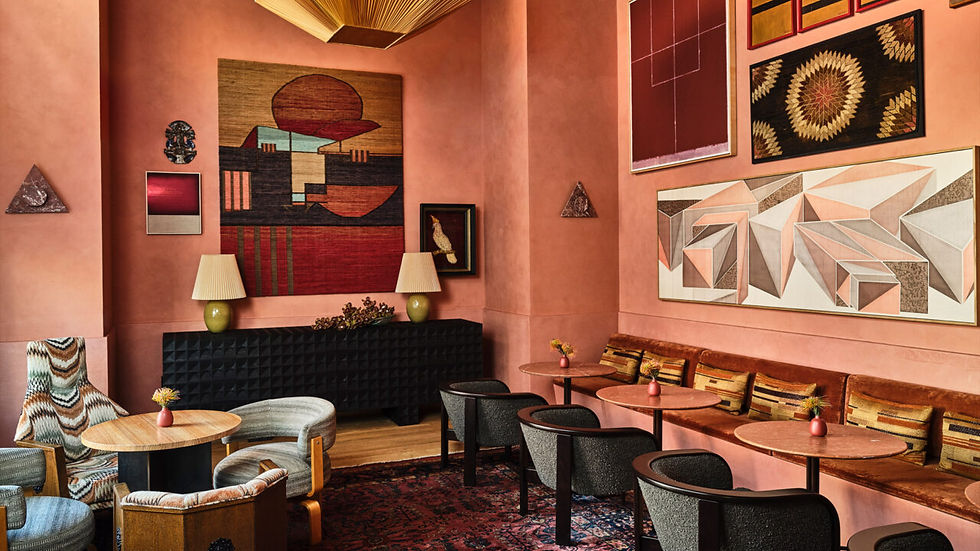
I want to see a real room and study it, like the picture from the Dahlia above. I've had the privilege to go there, so I know it's real. I want to look at the architectural decisions someone made, notice the colors and fabrics they chose, the proportions of the furniture, the way a light fixture sits against a ceiling, and the little accent piece that makes the whole room work.
I want to notice the details that someone thoughtfully placed there because their own brain and creativity led them to that decision.
Instead, I’m constantly questioning every image I see, resulting in cognitive fatigue, chronic skepticism, and ultimately the same kind of analysis paralysis that I get from asking AI what product I should purchase or sorting through reviews.
AI shouldn't become the brain
Analyzing products should clue you in on the fact that I do use AI every day. I use it to perfect every purchase, refine my skincare routine, and understand an emotional reaction to something I observed. I use it at work to riff on ideas, write email sequences that I then edit, and visualize ideas so I can see them before creating them in real life.
If someone were to ask me if it has made my life easier, I honestly cannot say it has. Yes, it has helped me finally find the right deodorant, but for the most part I run into decision loops. It’s caused me to second guess my own judgement.
I’ve also experienced what happens when people stop treating AI like a tool and start treating it like the answer. This is where I have a problem.
Coming from the tech world, we as the industry were some of the first to adopt AI. And with that, the first to adopt an over-reliance, making humans less thoughtful and brands less trustworthy.
It's unbelievable to me that people who have built companies for decades can seemingly throw away so much knowledge and skill and fully rely on whatever AI suggests. The fact that something can be generated quickly doesn't mean it should be. And the fact that AI can do something doesn't mean that the person who spent years learning how to do it no longer has value.
I've seen years of my own skill and expertise tossed aside in literal minutes in preference to what AI suggested was “better”.
When you start questioning what you know
Like many people in the same industry, this caused an identity crisis for me. When something you've spent years learning can suddenly be replaced in minutes, it's hard not to question what your expertise is actually worth.
I let myself dwell in it for a bit, but soon realized it was probably one of the best things that could have happened to me. It forced me to think about what I actually wanted.
For me, it was a sign that I needed to pursue what I've always known I was truly meant to do. It helped me prioritize myself and the things in my personal life that I should have always prioritized but didn't because of that corporate grind.
You answer the email at night, work when you're supposed to be off, and put your own interests on hold because there's always something else that needs to get done. Then eventually, you forget what you were actually working toward in the first place.
The crisis is what brought me back to design.
Protecting design
I think there's something worth protecting here. And I don’t need to refuse AI or pretend technology isn't going to change the way we work to do so.
This is about protecting the human. The painter who has spent years developing a style. The graphic designer who knows when a few pixels are slightly off. The interior designer who can walk into a room and immediately see that moving a chair six inches will change everything. The florist who knows exactly which flower feels right next to another.
It’s that knowledge that comes from years of paying attention that we must value and protect.
The value of making something yours
For all the artists and designers in the world, I think we have to stay true to our craft and encourage the people around us to do the same.
It's easy to question your own skills when you're constantly being shown how quickly something can be generated. It's a new conflict we’re all navigating to wonder whether what you've spent years learning still matters, or whether you should be doing things differently just to keep up.
I think the answer is to keep developing the things that make you good at what you do. Keep paying attention and making things, even when it feels like the world is already making too much.
I don't want to look at a room and wonder whether it exists. I want to see the decisions someone made and appreciate that strange little chair or wonder what made them think to put two particular colors together.
I want to see the brush strokes, the imperfect photograph, the handwritten sketch, and the flower arrangement that isn't quite symmetrical and yet all too real and beautiful.
I want to see evidence that someone cared and that is what’s worth protecting.


Comments